
Bathrooms are the most common site of injury for older adults at home, and the shower is often the riskiest spot in the room. A walk-in shower designed with senior safety in mind can turn that risk into one of the safest rooms in the house. Here are the questions people ask most when they start planning one.
Why is a walk-in shower safer than a tub-shower combo?
A traditional tub-shower requires stepping over a high wall to get in and out, which is a major fall risk for anyone with limited mobility, balance issues, or joint pain. A walk-in shower replaces that step-over with a low or zero-threshold entry that can be crossed safely with a walker, cane, or wheelchair. It also reduces the physical effort of daily bathing, which helps preserve independence and can reduce reliance on a caregiver.
What safety features actually matter?
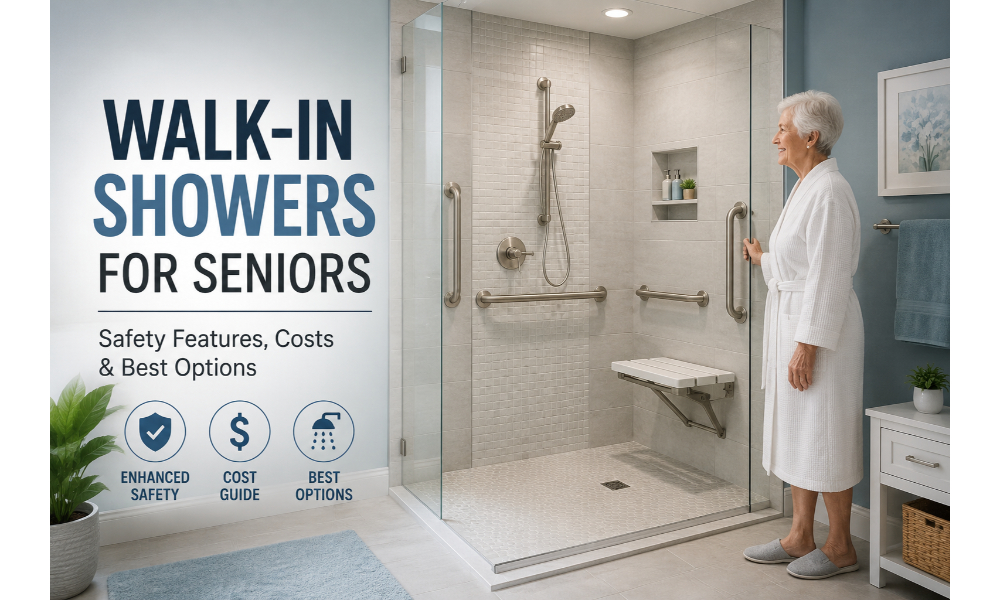
Zero-threshold or low-threshold entry. A curbless design eliminates stepping over anything. If a fully flush floor isn’t possible, look for a threshold no higher than half an inch.
Built-in or fold-down seating. A bench or fold-down seat lets someone sit while washing, reducing fatigue and the risk of losing balance on a wet floor.
Properly anchored grab bars. These need to be mounted into wall studs, not just adhesive-mounted, and placed near the entry, inside the shower, and near any seating. Towel bars are not a substitute — they’re not built to bear weight.
Slip-resistant flooring. Textured tile or a specialty shower pan with a high friction rating matters more than it might seem; avoid polished or glossy tile entirely in this space.
A handheld showerhead on a slide bar. This lets someone shower while seated and gives a caregiver an easier way to help if needed.
A wide door opening. At least 36 inches for wheelchair or walker access. Sliding doors, or no door at all with a curbless design, tend to be easier to navigate than swinging doors.
Lever-style controls and anti-scald valves. Levers are easier to grip than round knobs for anyone with arthritis, and anti-scald valves protect against sudden temperature spikes, which seniors are more vulnerable to.
Bright, even lighting. Reduces the chance of misjudging the edge of a seat, bar, or step.
What types of walk-in showers are available?
- Curbless tiled showers — fully custom, built into the floor with a sloped drain. The most seamless look, but the most extensive remodel.
- Prefabricated walk-in shower units — one-piece or multi-piece acrylic/fiberglass units with low thresholds built in. Faster and generally less expensive to install than custom tile.
- Walk-in tubs with a step-in threshold — not the same as a walk-in shower, but often confused with one. These have a door built into the tub wall and a seat, with a threshold higher than a curbless shower but lower than a standard tub.
- Tub-to-shower conversions — replace an existing tub with a walk-in shower using the same footprint, usually the most cost-effective retrofit.
How much does this cost?
| Prefabricated walk-in shower unit | Low–mid | Standardized parts, less labor |
| Tub-to-shower conversion | Mid | Reuses existing plumbing, but needs demolition |
| Fully custom curbless tile shower | Highest | Requires framing, sloped subfloor, waterproofing |
| Grab bars, anti-scald valve, handheld showerhead (retrofit only) | Low | Add-ons to an existing shower, no remodel needed |
Get quotes from two or three licensed contractors — regional labor rates and your existing bathroom layout affect price more than the fixtures themselves.
Is any financial help available?
- Medicaid waiver programs in many states cover accessibility renovations for qualifying individuals (Medicare itself typically does not).
- VA grants — Specially Adapted Housing (SAH) or Home Improvements and Structural Alterations (HISA) grants for veterans with service-connected disabilities.
- Area Agencies on Aging — many offer grants or low-interest loans for aging-in-place modifications.
- Tax deductions — home modifications made for medical necessity may qualify as a deductible medical expense; check with a tax professional.
Which option is right for my situation?
- Severe mobility needs or wheelchair access → a custom curbless shower with a wide entry.
- Want a faster, lower-cost upgrade → a prefabricated low-threshold unit with a built-in seat and grab bars.
- Working with a tight budget → retrofit the existing shower first: grab bars, a non-slip mat, a handheld showerhead, and a shower chair cover most of the safety benefit without a full remodel.
Final Thoughts
There’s no single “best” walk-in shower — the right choice depends on mobility level, budget, and how much of the existing bathroom you’re willing to rebuild. But regardless of which option you choose, the same short list of features — a low threshold, secure grab bars, slip-resistant flooring, and easy-to-use controls — is what actually prevents falls and makes daily bathing safer.