
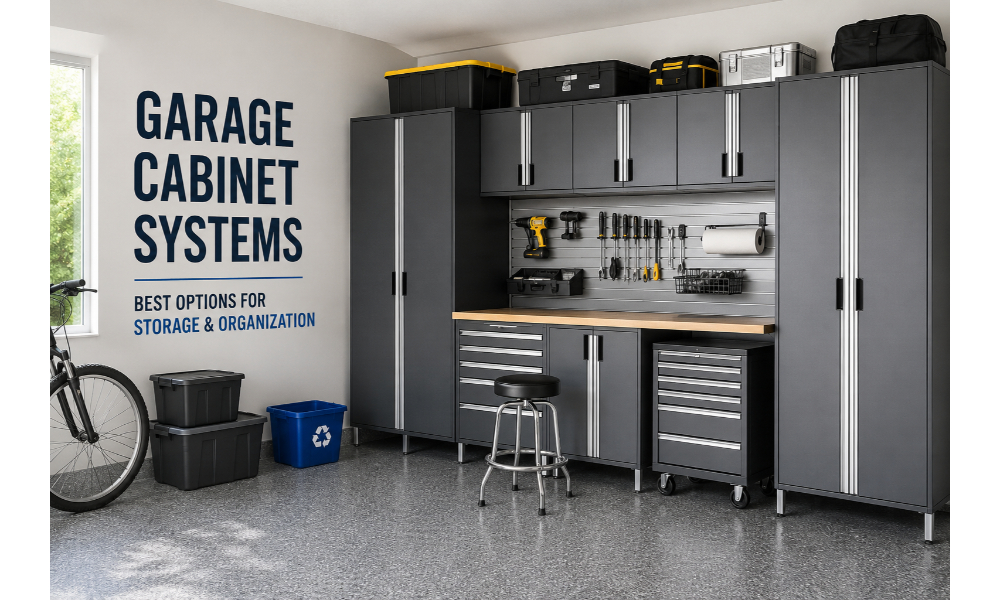
The garage tends to become the default storage space for everything that doesn’t have a home elsewhere — tools, sports gear, holiday decorations, paint cans, that one unopened box from a move years ago. A good cabinet system fixes this by giving every category of stuff a defined place, protecting it from dust and moisture, and freeing up the floor for what a garage is actually meant for. This guide compares your options directly so you can pick the right system rather than the most popular one.
Open Shelving vs. Enclosed Cabinets
| Cost | Lower | Higher |
| Protects from dust/pests | No | Yes |
| Hides clutter | No | Yes |
| Installation speed | Fast | Moderate |
| Best for | Frequently grabbed items, bins | Bulk storage, anything sensitive to moisture |
Most well-designed garages use both: enclosed lower cabinets for bulk or messy storage, with open shelving or pegboard above for tools you reach for often.
Comparing Cabinet System Types
Modular cabinet systems — Prefabricated steel or heavy-duty polymer units in standard widths, arranged along one or more walls. *Best for:* most homeowners, since they install quickly and can be expanded over time.
Wall-mounted cabinets — Mounted above the floor rather than resting on it, keeping the floor completely clear for parking or rolling out equipment. *Best for:* garages where floor space is at a premium; *watch out for:* they need solid wall anchoring and typically hold less than floor-to-ceiling units.
Freestanding base cabinets with a countertop — Cabinets topped with a work surface, functioning as a workbench with storage underneath. *Best for:* garages that double as a workshop.
Slatwall or track panel systems — Grooved wall panels that accept hooks, small shelves, and baskets. *Best for:* frequently used hand tools, ladders, and sports gear you want visible and quick to grab; usually paired with cabinets rather than used alone.
Overhead storage racks — Ceiling-mounted platforms for bulky, infrequently used items. *Best for:* holiday decorations, luggage, and seasonal gear that should sit well above head height.
Comparing Materials
| Steel | Excellent | Very high (can dent under heavy impact) | Highest |
| Powder-coated steel / coated MDF | Good | Moderate | Mid |
| High-density polymer | Excellent (won’t rust/rot/warp) | Moderate for very heavy loads | Mid |
| Wood | Poor unless heavily sealed | Low in garage conditions | Varies |
If your garage deals with humidity or occasional flooding, polymer or steel are the only materials worth considering — wood is a poor fit for this environment regardless of finish.
Layout Checklist
- Map zones by category first: tools, automotive supplies, sports and recreation gear, seasonal items, lawn and garden. Decide this before buying anything.
- Keep frequently used items at waist-to-shoulder height — the same prime-real-estate principle that applies to kitchen pantries applies here.
- Measure your car’s door swing before finalizing cabinet depth and placement on the driver’s side wall.
- Use the ceiling. Overhead racks absorb bulky, rarely used items without competing for wall or floor cabinet space.
- Plan for growth. A modular system lets you add another unit next year instead of replacing a built-in system wholesale.
What It Costs
| DIY modular kit (steel or polymer) | Lowest | Good starting point for a single wall of storage |
| Professionally installed custom system | Highest | Better material quality, precise fit, installation warranty |
| Add-ons (slatwall, overhead racks, workbench tops) | Priced per unit/foot | Can be added incrementally over time |
Get a few local installer quotes alongside pricing out a comparable DIY kit — that comparison shows you exactly what the labor and customization premium buys.
Best Option by Situation
- Tight budget → DIY modular steel or polymer cabinets plus pegboard or slatwall for tools.
- Humid or flood-prone garage → high-density polymer cabinets; they won’t rust, rot, or absorb moisture.
- Workshop use → freestanding base cabinets topped with a durable workbench surface.
- Maximizing floor space → wall-mounted cabinets combined with an overhead rack.
- Fully custom look → professionally installed steel cabinets with matching slatwall and countertop, designed around your exact dimensions.
Bottom Line
The right garage cabinet system isn’t the most expensive one — it’s the one that matches your climate, your actual storage categories, and how often you use each item. Sort first, choose a material suited to your garage’s humidity, and build the layout around frequency of use.
Frequently Asked Questions
Can garage cabinets be installed on an unfinished concrete wall?
Yes, but you’ll need anchors rated for masonry rather than standard drywall anchors, and it’s worth confirming the wall is dry and free of cracks before mounting anything heavy. Wall-mounted cabinets in particular depend on a solid anchor point to hold weight safely.
Will garage cabinets survive extreme summer heat or winter cold? Steel and high-density polymer both handle temperature swings well. Wood and standard laminate are the materials most likely to warp, crack, or delaminate over repeated seasonal cycles, which is why they’re rarely recommended for garage use regardless of finish.
How much weight can a typical wall-mounted garage cabinet hold?
This varies by manufacturer and how securely it’s anchored into studs, so always check the specific weight rating before loading it with heavy tools, paint cans, or equipment. When in doubt, put heavier items in floor-standing cabinets instead.
Is it worth paying for a professional garage cabinet installation instead of DIY?
If you want a precise, custom fit for an oddly shaped garage, or you’re not confident anchoring heavy units into studs or masonry, professional installation is worth the premium. For a straightforward single wall of modular units, DIY is usually a reasonable and much cheaper option.
Can I mix cabinet brands and materials in the same garage?
Yes, though matching a single system tends to look more cohesive and ensures compatible mounting hardware. Mixing is common when adding overhead racks or slatwall from a different brand than your base cabinets, since those add-ons are rarely brand-specific.