

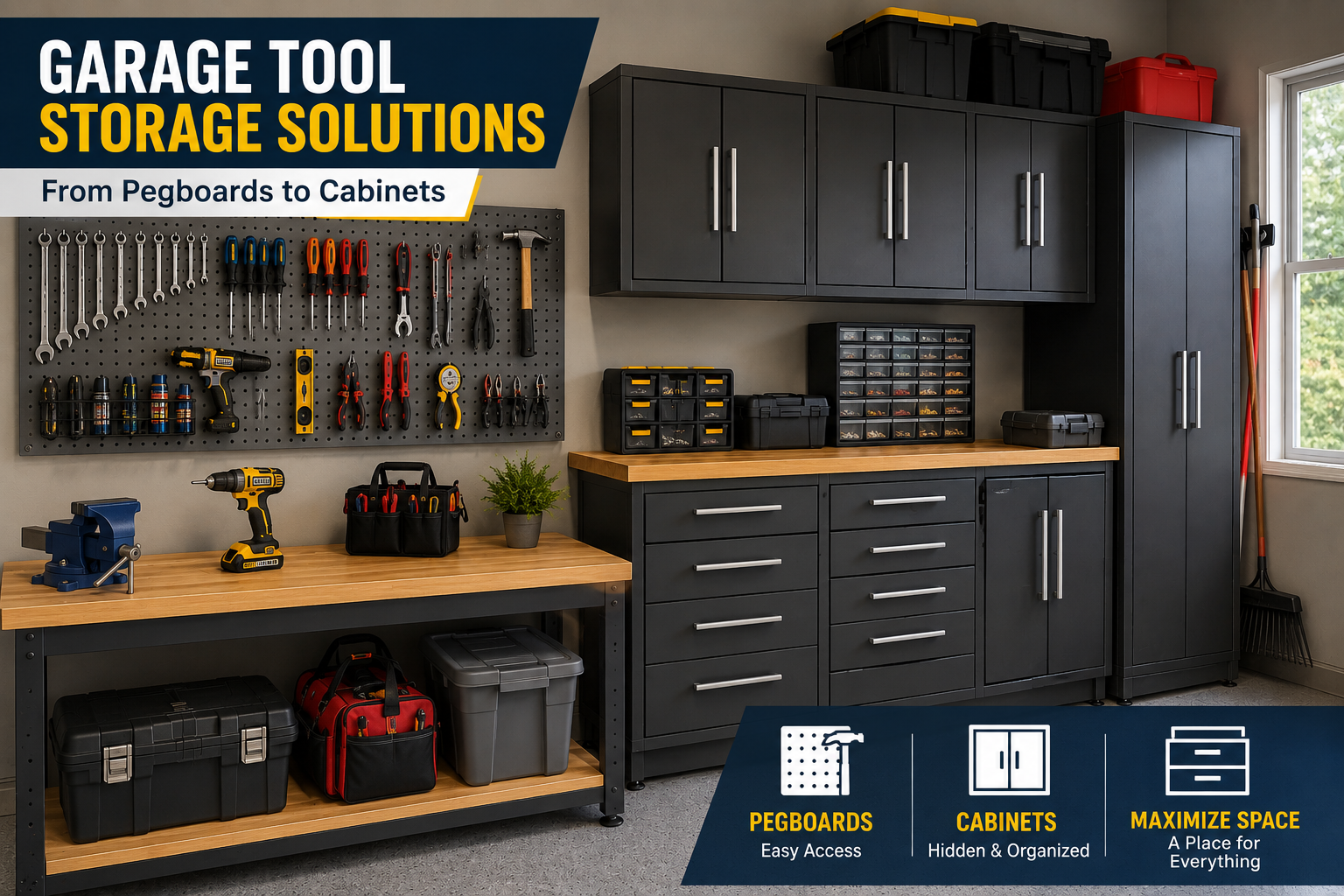
Most garages don’t lose function because they’re small — they lose it because tools have no assigned home. A drill ends up on a shelf next to paint cans, wrenches scatter across a workbench, and eventually the car gets parked in the driveway because there’s no room left inside. The fix isn’t necessarily more space; it’s the right storage system matched to how you actually use your tools.
This guide breaks down every major garage tool storage option — wall-mounted, rolling, modular — along with cost ranges, pros and cons, small-garage fixes, and the mistakes that quietly waste the most space.
What Types of Garage Tool Organizers Are Available?
Garage storage generally falls into five categories, and most well-organized garages use a mix rather than just one:
- Pegboards — a wall panel with hooks for hand tools, ideal for frequently used items you want visible and reachable
- Wall-mounted cabinets — enclosed storage that keeps tools dust-free and out of sight
- Slatwall panels — similar to pegboards but with heavier-duty hooks and bins, better suited to power tools
- Rolling tool chests — mobile, drawer-based units that can be wheeled to wherever the job is happening
- Overhead storage racks — ceiling-mounted platforms for seasonal or rarely used items, freeing up floor and wall space
None of these is a universal best option — the right pick depends on tool volume, garage size, and how often things get pulled out and put back.
Wall-Mounted vs Rolling Tool Storage: Which Is Better?
This is the single biggest decision point for most garages, since it shapes everything else about the layout.
| Factor | Wall-Mounted Storage | Rolling Storage |
| Floor space used | None — frees up the floor entirely | Takes up floor footprint, even when parked |
| Mobility | Fixed in place | Can be wheeled to the driveway, workbench, or job site |
| Best for | Hand tools used often, visual organization | Larger tool collections, power tools, mixed hardware |
| Weight capacity | Limited by wall anchors and studs | Very high — chests can hold dense, heavy loads |
| Typical cost | Lower for basic pegboards | Higher, especially for multi-drawer chests |
Garages with limited floor space and mostly hand tools tend to do better with wall-mounted systems. Garages supporting real project work — engine repairs, woodworking, serious DIY — usually need the drawer depth and weight capacity a rolling chest provides.
Pegboards vs Cabinets vs Tool Chests: How Do They Compare?
| System | Pros | Cons | Typical Cost |
| Pegboard | Cheap, customizable, tools stay visible | Dust exposure, limited weight capacity, no lock | $20–$80 |
| Wall cabinet | Enclosed, dust-free, lockable | Higher upfront cost, needs stud mounting | $100–$400 |
| Rolling tool chest | Mobile, high capacity, drawer organization | Takes floor space, heavier units are pricier | $150–$1,000+ |
A hybrid setup — pegboard for daily-use hand tools, a rolling chest for power tools and hardware — is usually the most practical answer rather than picking just one system.
What Are the Best Garage Organizer Options by Budget?
Under $100
- A basic pegboard panel with hook assortment
- Stackable plastic bins for hardware and small parts
- Magnetic strips for screwdrivers and metal hand tools
$100–$400
- A slatwall system with modular bins and heavy-duty hooks
- A small rolling tool cart with two or three drawers
- A wall-mounted lockable cabinet for power tools
$400 and up
- A full rolling tool chest with multiple drawers and a locking top box
- A modular wall system combining cabinets, pegboard, and shelving
- Overhead ceiling racks paired with a full slatwall buildout
How Do You Organize Tools in a Small Garage?
Compact garages benefit from vertical thinking over floor-based storage:
- Mount pegboard or slatwall above the workbench instead of adding freestanding shelving
- Choose a slim rolling cart that tucks under a bench when not in use
- Use door-mounted or corner shelving units that don’t intrude on walking space
- Install an overhead rack for seasonal items — holiday decorations, camping gear — to clear floor-level clutter
- Fold-down workbenches free up the entire floor when not actively in use
What Are Some DIY Garage Tool Organization Ideas?
Not every solution needs a store-bought system:
- Build a simple plywood pegboard frame and paint it to match the garage
- Repurpose old kitchen cabinets as enclosed tool storage
- Use PVC pipe segments mounted on a board to hold long-handled tools like rakes and brooms
- Mount recycled coffee cans or jars for small hardware like screws and nails
- Attach a magnetic knife strip to hold metal hand tools within reach
DIY builds cost less but require more upfront time and a basic comfort level with tools — worth weighing against buying a ready-made unit if time is tighter than budget.
What Mistakes Do People Commonly Make When Storing Tools?
- Mounting pegboard or cabinets without hitting wall studs, risking collapse under weight
- Overloading rolling drawers past their rated weight capacity
- Storing power tools loosely instead of in cases or padded drawers
- Ignoring humidity — bare metal tools left in a damp garage rust quickly
- Placing frequently used tools out of easy reach, and rarely used ones front and center
- Skipping labels on bins, which slows everyone down once several people share the space
What Safety Considerations Matter Most in Garage Tool Storage?
- Anchor heavy wall storage into studs, not just drywall, to prevent it pulling loose
- Store sharp or bladed tools in sheaths or closed cases, not loose on open shelving
- Keep flammable materials — solvents, propane, gasoline — away from tool storage and heat sources
- Lock cabinets or chests if children have access to the garage
- Leave clear walking paths; tools stored on the floor are a common tripping hazard
What’s a Space-Saving Layout That Works for Most Garages?
A layout that scales well from small garages to two-car spaces:
- Pegboard or slatwall directly above the workbench for daily-use hand tools
- A rolling tool chest positioned under or beside the bench, tucked out of the main walking path
- Wall cabinets along a side wall for power tools and anything that needs to stay dust-free
- Overhead racks near the garage door for seasonal or rarely used items
- Floor space kept entirely clear for the vehicle and for moving around safely
How Do You Maintain a Garage Tool Storage System Long-Term?
| Frequency | Maintenance Task |
| Weekly | Return any tools left on the workbench to their assigned spot |
| Monthly | Wipe down metal tools to prevent rust, check pegboard hooks for wear |
| Every 6 months | Reassess which tools are used often versus rarely, and re-zone accordingly |
| Yearly | Inspect wall anchors and rolling chest wheels/casters for wear or looseness |
A five-minute reset at the end of each project keeps a garage system functional for years, rather than needing another full overhaul.
Frequently Asked Questions
What is the best garage tool storage system for beginners?
A basic pegboard combined with a few stackable bins is usually the easiest and least expensive starting point, with room to add cabinets or a rolling chest later.
Are pegboards or cabinets better for garage tool storage?
Pegboards suit frequently used hand tools that benefit from visibility, while cabinets suit power tools and anything that needs to stay enclosed and dust-free — most garages benefit from using both.
How much does it cost to organize a garage with tool storage?
Costs range widely: a basic pegboard setup can run under $100, while a full rolling chest and cabinet combination can run several hundred to over a thousand dollars depending on size and brand.
What’s the best tool storage for a small garage?
Wall-mounted pegboard or slatwall paired with a slim rolling cart tends to work best, since it keeps the floor clear for parking and walking space.
How do I stop my garage tools from rusting?
Store metal tools in a dry cabinet where possible, wipe them down after use, and consider a small dehumidifier if the garage tends to stay humid.